Della O’Brien is a content marketer and blog writer with experience in SEO-driven content marketing since 2019. She has written for agencies and platforms including Mace Media, Octopus Labs, and Content Fly. Since 2022, she has focused on destination marketing and short-term rental promotion, creating blog content that drives traffic, engagement, and bookings.
To succeed as an SEO content marketer, you must balance expertise, proof, and search demand. Writing a blog post that ranks on page one in 2026 requires moving beyond simple word counts and focusing on high-intent informational keywords that position you as an authority in your niche.
This step-by-step guide walks you through the foundational process of creating content that satisfies both search engines and human readers.
Step 1: Identify Search Intent
Before writing a single word, you must understand search intent—the “why” behind a user’s query. To rank effectively, your content must match what the user is looking for, whether it is educational information, a specific product, or a guide. If your post doesn’t align with the intent of the top-ranking results, it will struggle to gain traction regardless of how well it is written.
Step 2: Conduct Keyword Research
Effective keyword research for bloggers involves finding a balance between search volume and competition. Focus on:
• Primary Keywords: Your main topic (e.g., “SEO blog writing”).
• Secondary Keywords: Related terms that provide context (e.g., “on-page SEO for blogs,” “content marketing strategy”).
• Niche Relevance: Especially if you are in a specialized field like destination marketing or short-term rentals, targeting lower-competition, high-relevance terms helps you rank faster.
Step 3: Structure for Readability and Depth
Search engines favor content that is well-structured and easy to navigate. Use a clear hierarchy of headings (H1, H2, H3) to organize your thoughts:
• H1: Your main title, including your primary keyword.
• H2s: Sub-topics that break down the process (e.g., “How SEO Content Marketing Works” or “Measuring Success”).
• Formatting: Use bullet points, short paragraphs, and bold text to improve readability for “scanners”.
Step 4: Execute On-Page SEO Best Practices
Once your content is drafted, optimize the technical elements to ensure search engines can crawl and understand your post:
• URL Slugs: Keep them short and keyword-rich.
• Meta Titles and Descriptions: Write compelling snippets that encourage clicks from the search results page.
• Internal Linking: Follow a hub-and-spoke model. Link back to your SEO Content Marketing Pillar Page and connect your new post to at least 1–2 other related articles to distribute “link equity” across your site.
Step 5: Plan for Regular Updates
SEO is not “set it and forget it.” High-ranking content requires a content refresh strategy. Plan to update your posts every 6–9 months by adding new keywords, refreshing outdated information, and checking your internal links to maintain your rankings.
——————————————————————————–
About the AuthorDella O’Brien is an SEO content marketer and blog writer with experience in SEO-driven content marketing since 2019. She specializes in creating blog content that drives traffic, engagement, and bookings, specifically within the destination marketing and short-term rental niches.
One of the biggest benefits of blogging is SEO. This blogger tutorial walks you through how to create a content creation guide for your blog.
The last time I posted, we went over the benefits of blogging, and I mentioned using your results from Answer the Public (or a similar website) to create a map for your website. Then, you can use it as a guide for content creation.
What are some of the biggest benefits of blogging?
Blogging enhances your site’s SEO.
Search Engine Optimization is vital for your website because a website optimized well for the search engines ranks higher on the SERP. Since many people won’t scroll through to page two of the Search Engine Results Page (SERP), most wellness bloggers aim for page one of the search results for the keywords most relevant to their target customer.
When you write blog posts designed for SEO and your target customer, your customers can find you and your content is more engaging. If your blog posts are not optimized for search, you’ll only get your content in front of your target customer if you use ads or if you are using social media powerfully.
Establish credibility.
Writing SEO blog posts shows search engines that you have content that addresses your target customers’ critical issues. More importantly, you set yourself up as an expert in your field. This helps with many things, one of which is your trust score on Google.
Earn Google’s trust.
Google’s trust is imperative because if Google doesn’t think you know what you’re talking about, it will not suggest your content to your target customers.
Blogger Tutorial: Use Answer the Public to Design a Content Creation Guide for Your Blog.
Friendly reminder: I am using Answer the Public as my example of a keyword tool, but there are many others, one of which is Ubersuggest by Neil Patel.
The video above illustrates the instructions, numbers 1-6.
Go to Answer the Public. If you have a Pro Account, you can log in. Otherwise, you can use the free version.
In the search bar, type in a word or two to get a list of popular related terms. For our example, I’ll use the phrase “wellness tips.”
Select your country and language.
Click “Search.”
You’ll notice several questions, prepositions, comparisons, alphabetical, and related. There is also the option to Download CSV. And underneath those options is a diagram of the questions typed into search.
Here, we will download the CSV.
On the Excel Sheet
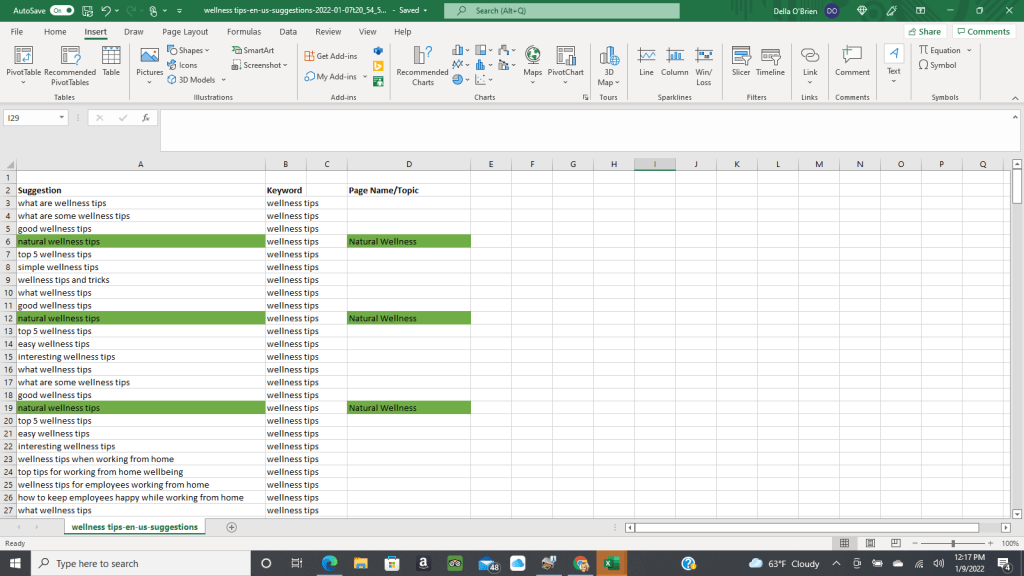
After downloading the CSV, the terms will be saved in an Excel sheet. Open the sheet and look at Column A.
As you follow the column to the bottom of the screen, you will see that the column indicates whether the suggestions are questions, propositions, comparisons, or alphabetical suggestions.
Column B has the modifier. For example, the first modifier listed is “Are.” And Column C has the suggested keyword or keyword phrase.
Moving over, Column F has keywords listed. After glancing at all the info and getting accustomed to where everything is, you might think of a way of organizing this information differently than I suggest. That is ok. However, I recommend deleting all columns except the Suggestions column and the Keywords. It’s easier to find everything.
Then, add Page Name to the top of the next column.You might choose to color code the page names if that makes finding info on the spreadsheet easier.
Then, you’ll go through the page and find a few suggested keyword phrases that have something in common. You will use the commonality as your page name/topic on the sheet. For example, I chose to have a page titled “Natural Wellness” because it’s listed several times on the sheet.
However, after further inspection, I realized the term “natural wellness” was repeated, verbatim, in each of its appearances on the sheet. With no need to see the term multiple times, you will have a better visualization if you delete the repetitive phrases.
You can find the repeated suggestions either by
typing CTR+F on your keyboard
clicking analyze data and arranging by suggestions
clicking data, then remove duplicates.
Then, go through and find another commonality. Keep labeling until every suggestion has a Page Name/Topic assigned. Finding the commonalities is easier when you choose the second option above for finding the repeated suggestions- clicking analyze data and arranging by suggestions- because the suggestions column will be listed in alphabetical order.
You might choose to color-code by page name to make it easier to visualize the number of suggestions per page name.
In the image below, notice there is a page named “Top 5 X_[Post Title Idea]”. This is a post title that is a catchy for the reader. Readers love to select list posts like that.
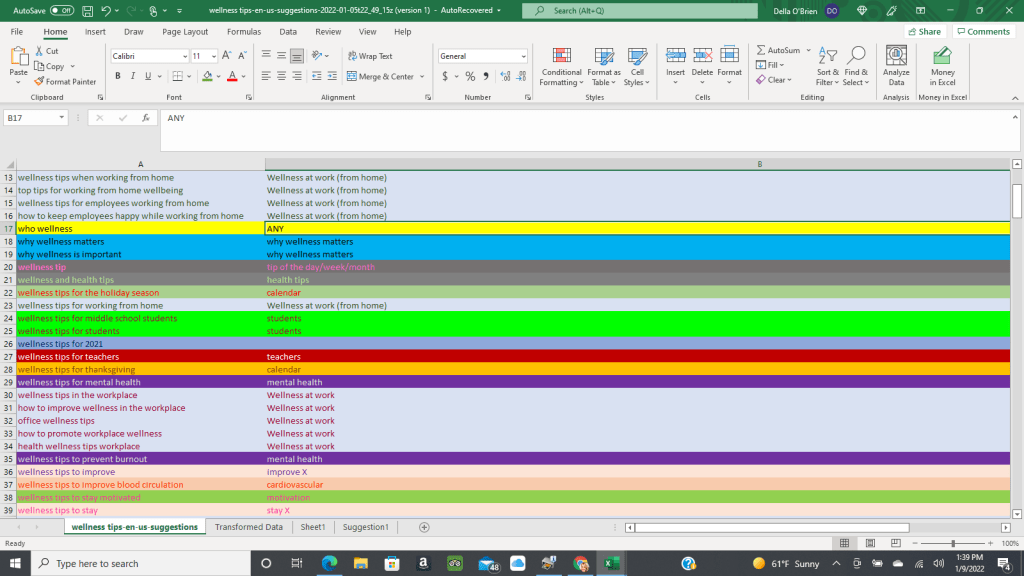
In the image below, you can see that some of the page names simply say “any”. That’s because these suggestions could work on many different page types.
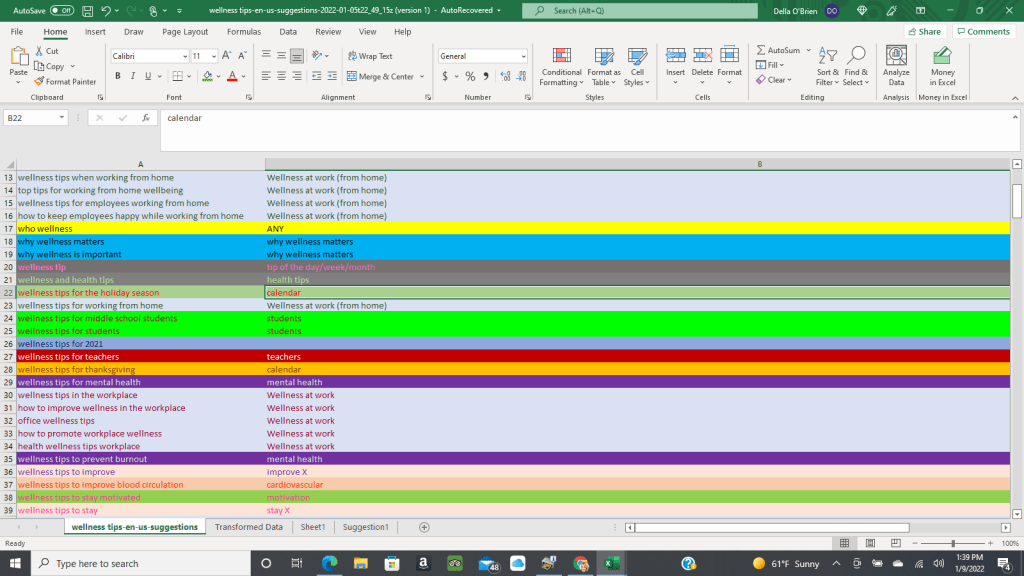
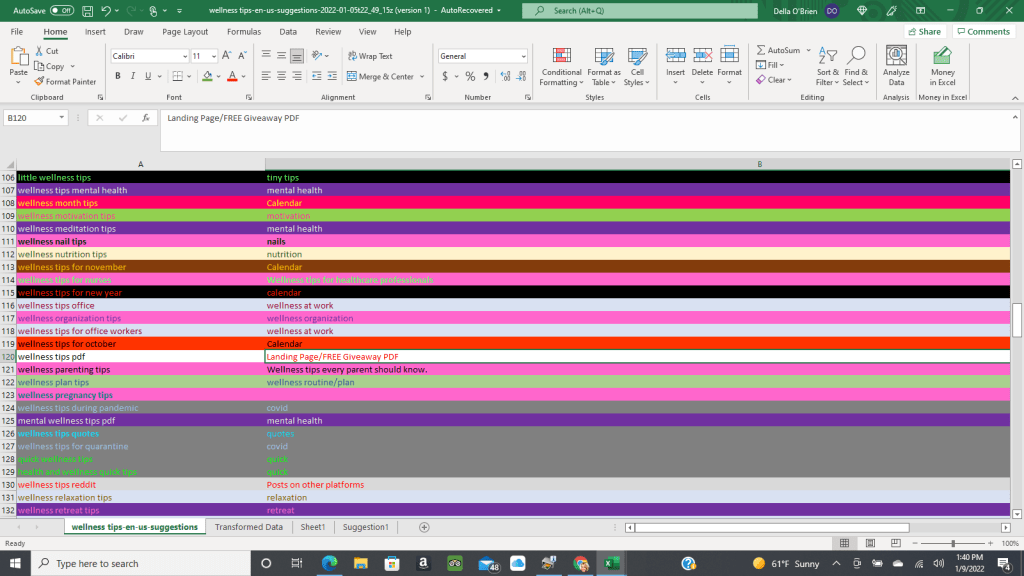
The image below shows a page titled “calendar”. The suggestions with this page name assigned to them are all relevant to months of the year, 2021 (which you can change to 2022), or specific holidays. Depending on how many posts you choose to write for each suggestion, you might have 1 calendar page for the whole year, or you could choose to have 1 calendar page for each month.
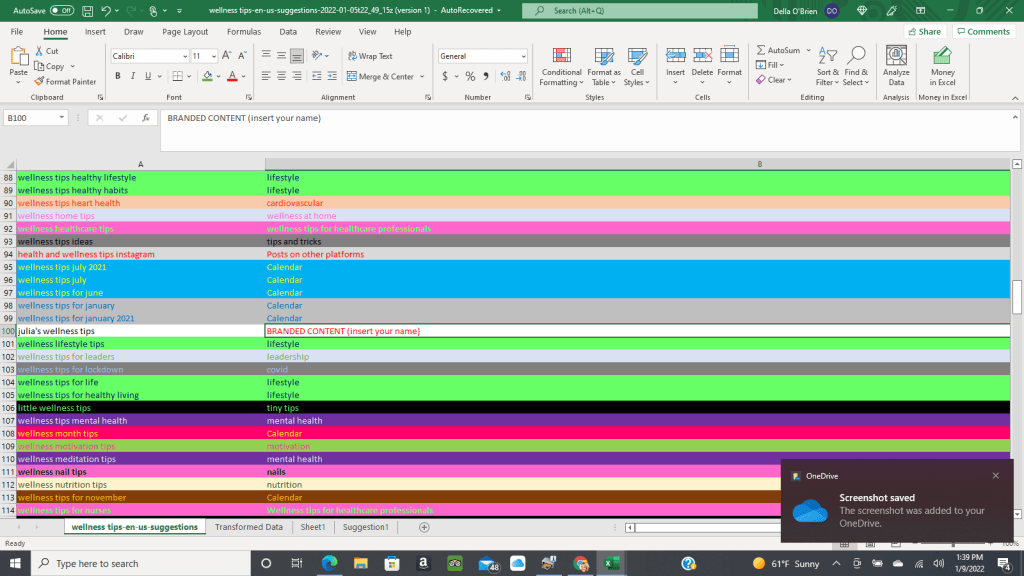
The image below has a page named “BRANDED CONTENT (insert your name)”. To use the suggestion, simply insert your name at the end, leaving a page named “health and wellness tips by Della”, for example.
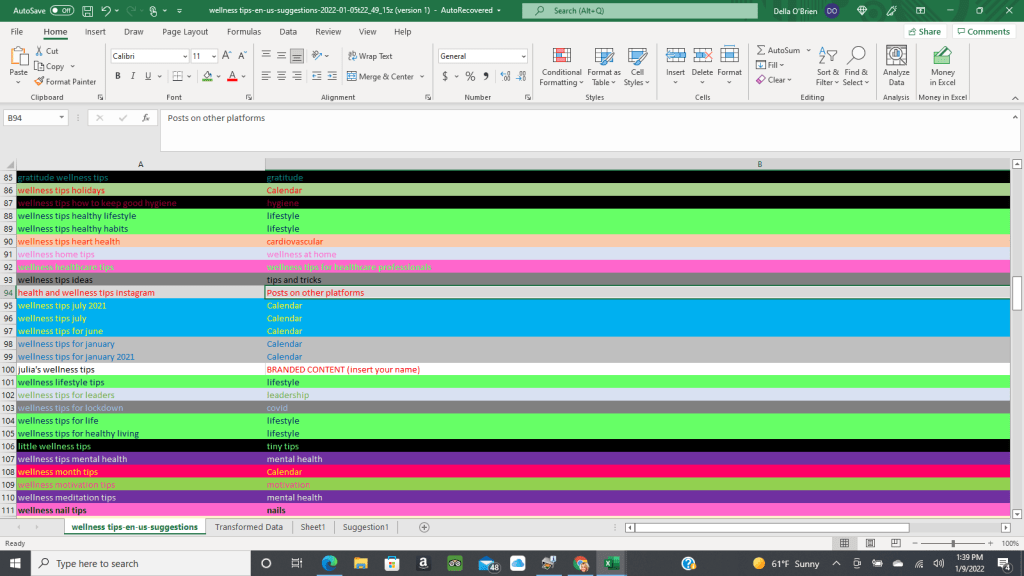
The image below has a page named “posts on other platforms”. That’s because this suggestion is for Instagram. You will find a couple of other suggestions for other platforms on this page.
The image below is another instance of branded content.
The image below shows a page named “Landing Page/FREE Giveaway PDF”. Here is an opportunity to offer something valuable to your target customer- something that is a quick fix for one of their problems- in exchange for their email address. This is great for building your email list so you can begin email marketing, which is still a fabulously successful tactic.
Once you have several suggestions for something that you think you are, hands down, the best person to answer questions about, you will know that you have the keywords ready for your first post, second, etc.
Bear in mind that you still need a customer journey for your readers.
A customer journey defines the topics your customer needs to master to reach their goals. Once you have the content creation guide created with SEO (like in this tutorial), align your content with the customer journey.
This allows you to solve a problem for your readers, so they keep coming back to read more or take the next step in their journey with you. Maybe they book a wellness coaching appointment, a training session, or whatever service you offer for them. This could also include purchasing products- However you define your wellness business success.
What’s next?
With your initial keyword research complete and a few page names created with the keyword phrases to match, you have plenty of content suggestions. The next time I post, we’ll go over the customer journey.
Have questions or comments? Please feel free to post them in the comments section. Or you can send them to me in a contact form.
Della O’Brien is a wellness writer with three years of writing experience in the industry and over 20 years of experience working with various wellness products. You might have seen her work in Extraction Magazine, Terpenes and Testing Magazine, or CBD Health and Wellness Magazine, among other publications. Della offers writing and consulting services for those wanting to build a successful business through content creation.











 Content and Coaching by Della